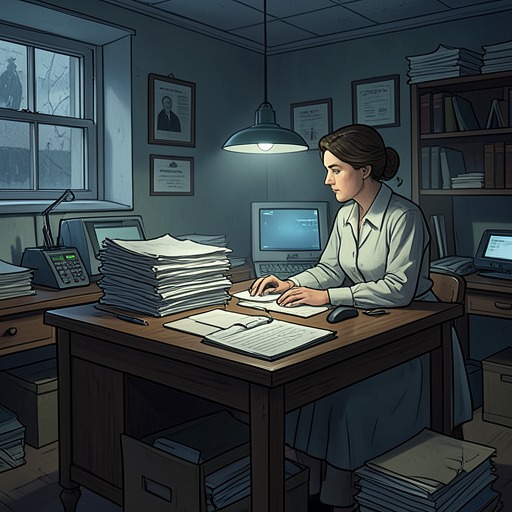
Vera Parini
The Other Black GirlVera Parini is one of Wagner Books’ most exalted editors and Nella Rogers’s supervisor of two years. She has given Nella access to meetings and practical guidance, and Nella has valued her skill in speaking to authors. But when Nella asks for a promotion and later challenges a manuscript’s portrayal of a Black character, Vera’s support proves conditional: she listens, yet also defers to workplace priorities and the author’s comfort. Her role is defined by that tension between mentorship and institutional gatekeeping.
Position and Editorial Practice
At an anniversary check-in, Nella asked Vera for a promotion. Vera answered with a long list of grievances about Nella’s performance as an assistant, including the claim that she devoted too much effort to extracurricular diversity meetings and not enough to core duties. Nella rejected the characterization of her diversity work as extracurricular, but did not argue; she thanked Vera and privately set aside her ambition to express her Black identity freely at work. The exchange shows Vera’s authority extending beyond day-to-day tasks: her evaluation helps determine which kinds of work count toward advancement.
Nella’s experience of Vera is not uniformly dismissive. She appreciates that Vera brings her to meetings, treats her as competent, and helps her distinguish a difficult agent from an acceptable one. Most importantly, Nella admires Vera’s editorial tact: Vera can tell an author that a book’s first half needs a complete rewrite while making the author feel that its second half deserves a Pulitzer. This ability makes Vera both a model of professional craft and a powerful figure whose judgment Nella wants to trust.
That trust is complicated by a previous instance in which Nella’s comments on a book favored by Vera appeared to be accepted in conversation but were missing from the marked-up pages later sent to the author. Nella noticed that her feedback was absent from both the final pages and the opening chapter. The omission gives her reason to wonder whether being asked for an opinion means that it will actually be carried forward into editorial decisions.
The Needles and Pins Dispute
When Vera asks for Nella’s assessment of Colin Franklin’s Needles and Pins, Nella initially avoids candor, calling the novel timely. Vera welcomes the term and connects the book to coverage on major media programs and to its treatment of the opioid epidemic. She then asks whether anything in the manuscript fails to land. Nella tries to explain her concern about Shartricia, a character depicted as nineteen, pregnant with her fifth child, and struggling with addiction, whose characterization Nella finds reductive and whose voice she considers inauthentic.
Nella eventually says that Colin should have been more creative with his only Black woman character. Vera responds by asking whether Nella’s criticism might itself be racist. Colin says that he feels accused of racism, and directs his attention to Vera rather than engaging Nella’s perspective. Nella is left feeling excluded from the exchange, despite having been asked to provide precisely the kind of editorial response a sensitivity read might offer. The scene puts Vera’s diplomatic skill under pressure: rather than first making space for Nella to develop her critique, she introduces a framing that allows Colin’s discomfort to dominate the conversation.
Vera later proposes postponing the discussion until Colin comes to the office, perhaps the following week, so that his response can be considered while they prepare Wagner Books’ offer for the novel. Nella would rather speak privately with Vera first, but Vera insists that they tell Colin in person and says she cannot focus amid the music blaring through the wall. When Colin arrives, Vera enthusiastically praises the manuscript as topical and direct, calling it a way to get readers talking about the opioid epidemic. Nella nods without speaking. The contrast between Vera’s enthusiastic public endorsement and the earlier invitation to critique makes clear how little room Nella’s reservations have in the acquisition conversation.
Work with Nella and Hazel-May McCall
Vera’s attention to Nella also appears inconsistent. After the conflict over Colin’s manuscript, Nella interprets Vera’s criticism as unusually stern and unfair, though she recognizes that she had once arrived late to work. Around the same period, Hazel-May McCall tells Nella that Vera offered her a book late at night after they met the previous afternoon. Nella notes that she had spent substantial time with Vera that day, which makes the timing stand out to her; the evidence establishes her suspicion and close observation, but does not establish why Vera sent the book when she did.
Nella responds to her uncertainty by monitoring colleagues’ writing utensils and recording the time and content of workplace interactions. She tracks Hazel-May McCall’s conversations with Vera as well. On one occasion, Hazel-May McCall spends approximately sixty-eight minutes behind Vera’s closed office door discussing The Lie. Hazel-May McCall emerges cheerful and thanks Vera for the conversation, while Nella, anxious about her own position, has eaten the entire emergency bag of pretzels she had meant to ration through the month. The episode presents Vera’s access and attention as objects of Nella’s scrutiny, without confirming that the long meeting signals any particular decision about either employee.
Later Acknowledgment and Significance
A dated work exchange over Crystal Soul offers a more routine view of Vera’s management. Nella brings five printed email replies from Sam Lewis about proposed cover designs and summarizes his preference among several layouts; she also recalls Leonard’s earlier refusal to produce new designs. Vera had asked for high-resolution glossy printouts, although she had already opened the emailed attachments herself. For Nella, the duplicate labor and wasted paper sharpen the sense that many of her tasks consume effort without producing a lasting result.
Vera later acknowledges that she has not been present and recognizes that Nella may connect this absence to the Colin situation. She says that the conflict may be part of the reason, though she is unsure, and apologizes if she made Nella uncomfortable after asking for her opinion. She also says she is glad Nella gave it. This apology recognizes the strain without resolving the underlying professional disagreement or undoing the earlier omission of Nella’s feedback. Vera therefore remains a complicated mentor: she offers real instruction and opportunity, but her actions also show how institutional priorities can narrow the value of the junior colleague’s expertise.